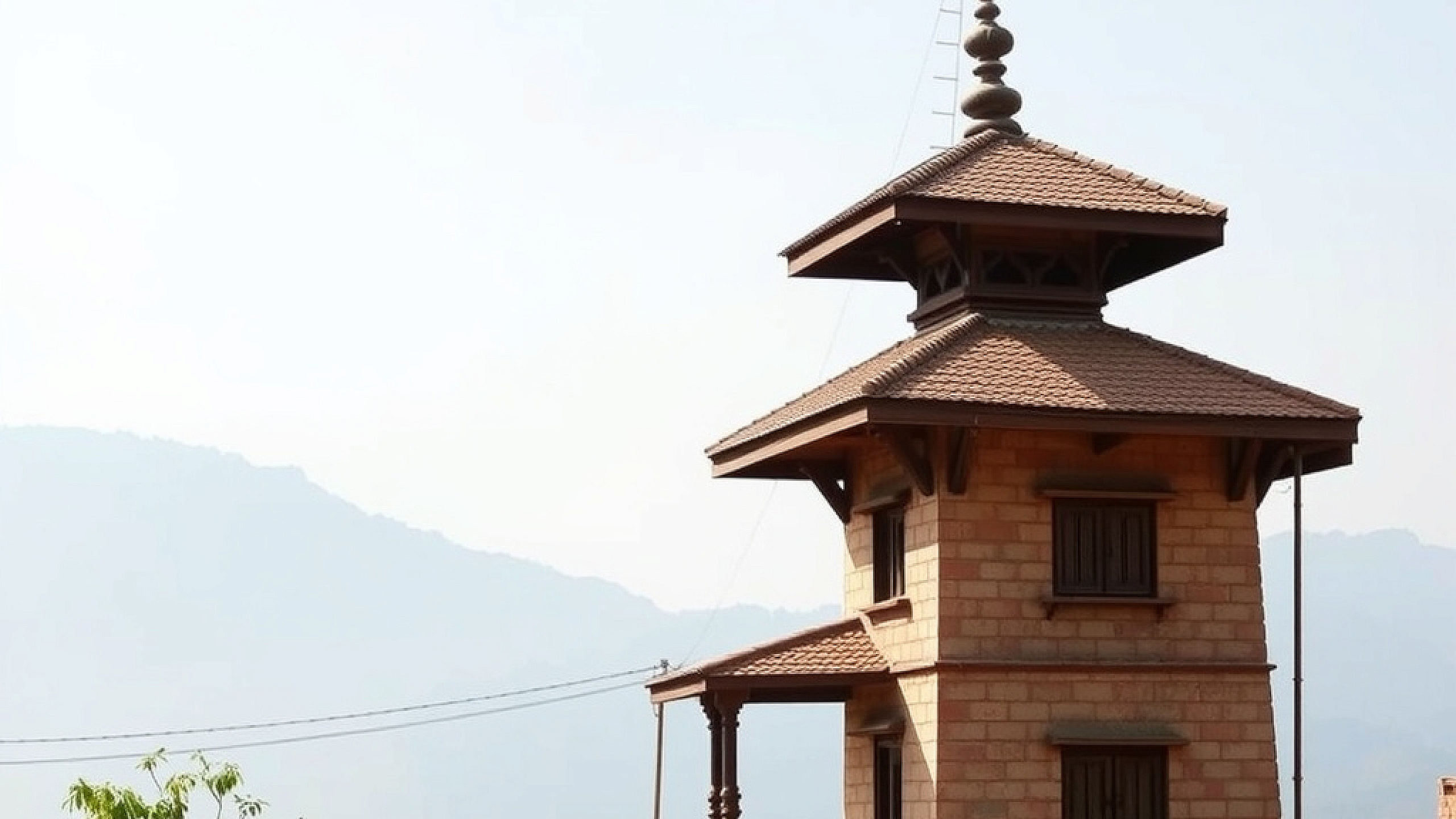
You are standing on a beautiful piece of land in the outskirts of Kathmandu or perhaps the fertile plains of Chitwan. The agent tells you it is exactly "1-2-1-3" or "0-5-10-0". If you aren't a veteran real estate trader, your head might start spinning. In Nepal, land isn't just numbers; it is a complex dual-system language that changes the moment you cross the hills into the Terai.
Mistakes in land calculation are expensive. A few 'Daam' here or a 'Dhur' there can translate to lakhs of NPR in today’s market. Whether you are planning to build a Vastu-compliant home or simply verifying your inheritance, understanding how to read your Lalpurja and convert those units into square feet is the first step toward a secure investment.
The Great Divide: Ropani vs. Bigha
Nepal uses two distinct traditional systems based on geography. If you are buying in the Kathmandu Valley or the hilly regions, you will deal with the Ropani-Aana-Paisa-Daam (RAPD) system. If you move south to the Terai districts like Jhapa, Rupandehi, or Banke, the system shifts to Bigha-Kattha-Dhur.
Why does this matter? Because 1 Aana is roughly 342.25 square feet, while 1 Kattha is a massive 3,645 square feet. Using the wrong mental calculator while comparing prices across regions is a recipe for financial disaster. To bridge this gap instantly, we have developed a Free Ropani, Aana, Bigha, Kattha Converter for Nepal to give you exact square foot and square meter figures.
How to Read Land Area on Your Lalpurja
When you look at your ownership certificate (Lalpurja), the area is usually listed in four columns. Here is how to decode them:
1. The Hilly System (RAPD)
- Ropani: The largest unit (approx. 5,476 sq. ft.).
- Aana: The most common unit for city plots (16 Aana = 1 Ropani).
- Paisa: Small unit used for precise sizing (4 Paisa = 1 Aana).
- Daam: The smallest fraction (4 Daam = 1 Paisa).
A reading of 0-4-2-1 means 0 Ropani, 4 Aana, 2 Paisa, and 1 Daam. This is approximately 1,557 square feet—a typical size for a compact urban home.
2. The Terai System (BKD)
- Bigha: The massive agricultural standard (approx. 72,900 sq. ft.).
- Kattha: The standard residential unit in the Terai (20 Kattha = 1 Bigha).
- Dhur: The smallest unit (20 Dhur = 1 Kattha).
A reading of 0-10-5 means 0 Bigha, 10 Kattha, and 5 Dhur. In the Terai, this is a significant amount of land, roughly 37,361 square feet.
Converting to Square Feet for Construction Estimates
Architects and engineers in Nepal usually work in square feet or square meters when calculating construction costs. For 2026, a standard quality build in Kathmandu costs around NPR 4,200 per sq. ft.. If you don't know your exact square footage, you cannot budget correctly.
For example, if you own 3 Aana of land, your total plot size is about 1,026.75 square feet. After leaving mandatory setbacks required by the municipality (usually 1.5 meters or 5 feet from the boundary), your actual "built-up area" might be closer to 700-800 square feet per floor. This conversion is crucial for our Construction Management team to give you a realistic quote.
Why Precision Matters for Vastu and Design
At Vastuveda Designs, we see many clients who think they have "4 Aana" but find out during the site survey that they only have 3.75 Aana. In a narrow Kathmandu plot, that missing 0.25 Aana (about 85 sq. ft.) is the difference between having a Vastu-compliant kitchen in the Southeast or being forced to move it to an inauspicious zone.
Using a precise converter allows us to:
- Calculate the Brahmasthan (center) of the house accurately.
- Determine the exact length of the compound wall (affecting your exterior design costs).
- Estimate the volume of soil excavation needed for the foundation.
Common Pitfalls in Land Conversion
One common mistake is rounding off numbers. In the RAPD system, 1 Daam might seem insignificant, but it represents about 21 square feet. At a land price of 50 lakhs per Aana, that tiny 'Daam' is worth over 30,000 NPR. Always use the four-digit decimal precision provided by our converter to ensure you aren't overpaying or under-measuring.
Another issue is the "Bato" (Road) deduction. Always check if the area on your Lalpurja includes the land that has been ceded for the public road. The "Kittanap" (trace map) will show the actual physical boundaries, which might differ slightly from the digital records.
Key Takeaway for Homeowners
Before you hire an architect or sign a construction contract, verify your land area. Don't rely on verbal estimates. Take your Lalpurja, identify the Ropani-Aana-Paisa-Daam or Bigha-Kattha-Dhur figures, and run them through our instant land unit converter. Knowing your exact square footage is the only way to ensure your budget, your Vastu alignment, and your legal documents are all in perfect harmony.
If you are confused about your plot's potential or need a professional site orientation study to start your project, the team at Vastuveda Designs is here to help you navigate the complexities of Nepali land and architecture.