Why Your 4-Anna Elevation Needs More Than Just Paint
Walk through the narrow streets of Imadol, Bhaktapur, or the hills of Kirtipur, and you will notice a common sight: rows of nearly identical 2.5-story concrete boxes. Most homeowners in Nepal spend months perfecting the internal floor plan but leave the exterior facade as an afterthought, often deciding on a paint color just days before the scaffolding comes down. But your house elevation is the first thing neighbors and guests see, and on a compact 4-anna plot, every square inch of that facade counts toward your property value and daily pride.
At Vastuveda Designs, we believe a house shouldn't just be functional; it should have a personality that reflects the local climate and your lifestyle. Elevating a standard RCC (Reinforced Cement Concrete) structure requires moving beyond flat walls and simple balconies. It requires a strategy that blends the traditional warmth of Nepali materials with the sleek lines of modern architecture.
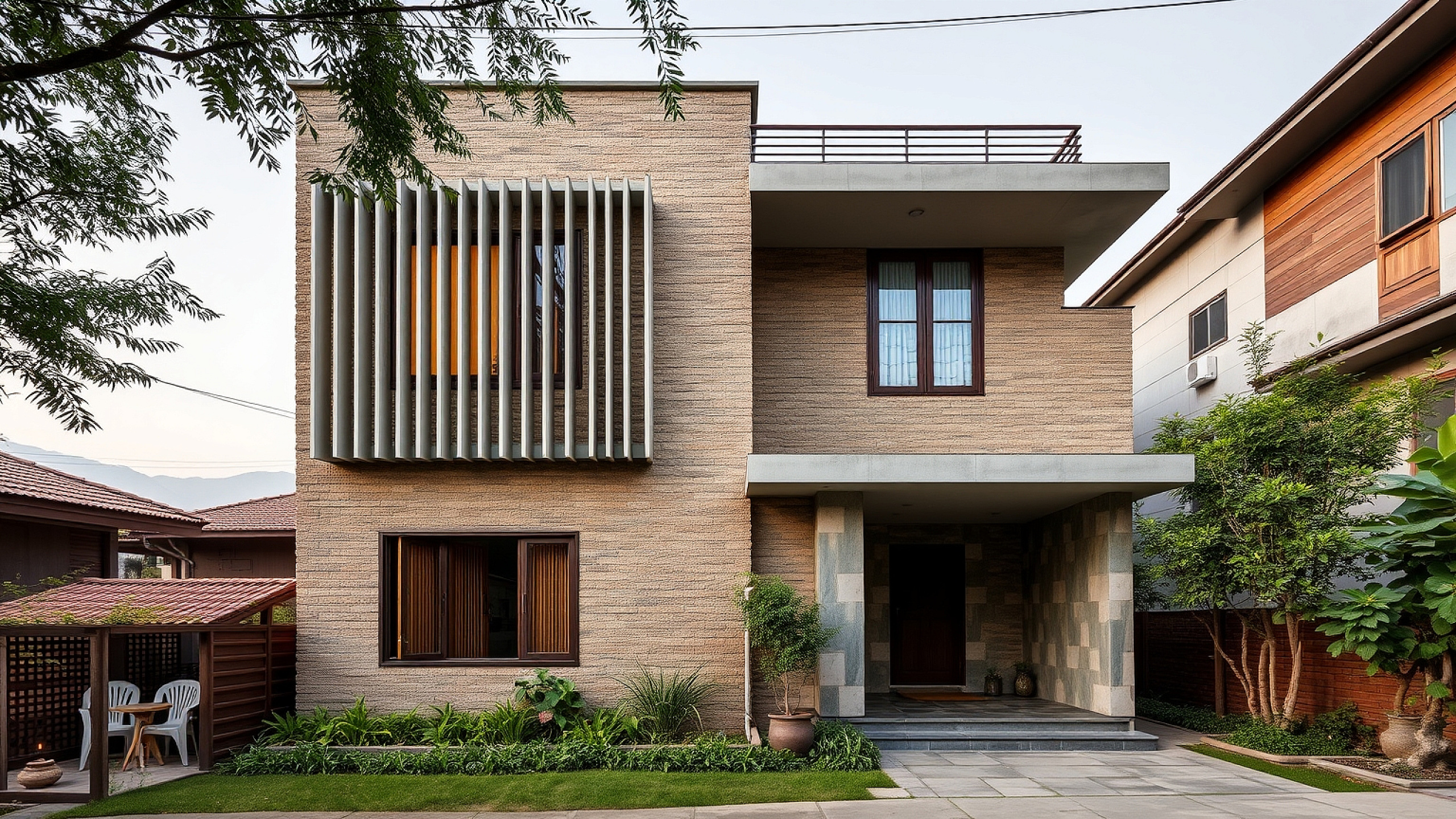
The Power of Verticality: Louvers and Box Windows
In Kathmandu’s densely packed neighborhoods, privacy is a luxury. Using aluminum or WPC (Wood Plastic Composite) vertical louvers on your facade is one of the most effective exterior facade and elevation design ideas for houses in Nepal. These slats provide a screen for your staircase windows or balcony, allowing light and air to pass through while blocking the direct view from the house across the street.
- WPC Louvers: These look like natural wood but survive the harsh Kathmandu sun and monsoon rain without warping or fading.
- Cantilevered Boxes: Instead of a flat wall, push out a portion of your master bedroom window by 1.5 to 2 feet. Framing this 'box' with a darker color or a different texture creates a 3D effect that makes a small house look significantly more expensive.
- Glass Balustrades: Replace heavy concrete railings with toughened glass. This opens up the view and makes the building feel lighter and less like a concrete block.
Texturing with Purpose: Stone Cladding and HPL Panels
Painting an entire house in one or two colors is the fastest way to make it look dated within five years. To create a timeless look, you need texture. In Nepal, we are blessed with incredible local stone options like slate and quartzite from districts like Nuwakot or Sindhupalchowk. Integrating these into your elevation design adds an earthy, grounded feel that paint simply cannot replicate.
High-Pressure Laminate (HPL) panels have also become a favorite in modern Nepali architecture. These are used to create wood-like accents on the 'soffits' (the underside of balconies) or as feature walls. While the initial cost of HPL can be around NPR 450 to 700 per square foot, the durability and the premium look it provides for a 4-anna home are unmatched. It creates a striking contrast against the raw grey of exposed concrete or the crisp white of a plastered wall.
The 'Night Facade': Lighting as a Design Element
Many Nepali homeowners overlook exterior lighting until the very end, often sticking a few generic bulbs under the porch. Professional elevation design treats light as a building material. Warm LED 'up-and-down' wall washers can transform a simple brick pillar into a dramatic feature at night. Highlighting the textures of your stone cladding or the lines of your louvers ensures your home looks as stunning at 8 PM as it does at 8 AM.
Practicality in the Nepali Climate
Design in Nepal isn't just about aesthetics; it’s about surviving the environment. Our monsoon season is brutal, and the dust in cities like Kathmandu is a constant battle. When choosing your exterior facade and elevation design ideas for houses in Nepal, consider these maintenance-friendly tips:
- Drip Grooves: Ensure your balconies and window sills have 'cornices' or drip grooves. This prevents rainwater from trickling down the facade and creating those ugly black streaks on your paint.
- Dust-Resistant Finishes: Avoid highly textured 'Sahara' or 'Ruff-Tuff' finishes in high-traffic areas where dust can settle. Opt for smooth, high-quality weather-coat paints or tiles for easier cleaning.
- Sloping Roof Accents: Even if you want a modern flat-roof look, incorporating a small sloping element over the top floor staircase cover (the 'munt') using UPVC or clay tiles can add a touch of traditional Nepali charm while helping with drainage.
Estimated Costs for Elevation Upgrades
Upgrading your facade does require a dedicated budget. For a standard 2.5-story house on a 4-anna plot, expect to spend an additional NPR 3,00,000 to 7,00,000 beyond basic plaster and paint if you want high-end materials like HPL, glass railings, and stone cladding. While this might seem like a significant investment, the 'curb appeal' can increase your property's resale value by 15-20% in competitive markets like Lalitpur or Pokhara.
The Key Takeaway
Your home’s exterior is the bridge between your private life and the public world. By focusing on depth through box windows, texture through stone and HPL, and privacy through louvers, you can turn a standard Nepali concrete house into a modern landmark. Architecture is not just about the space you live in, but the feeling your home projects to the world.
If you are planning to build or renovate and want an elevation that stands out in your neighborhood while remaining Vastu-compliant, the team at Vastuveda Designs is here to help you bridge the gap between traditional wisdom and modern aesthetics.