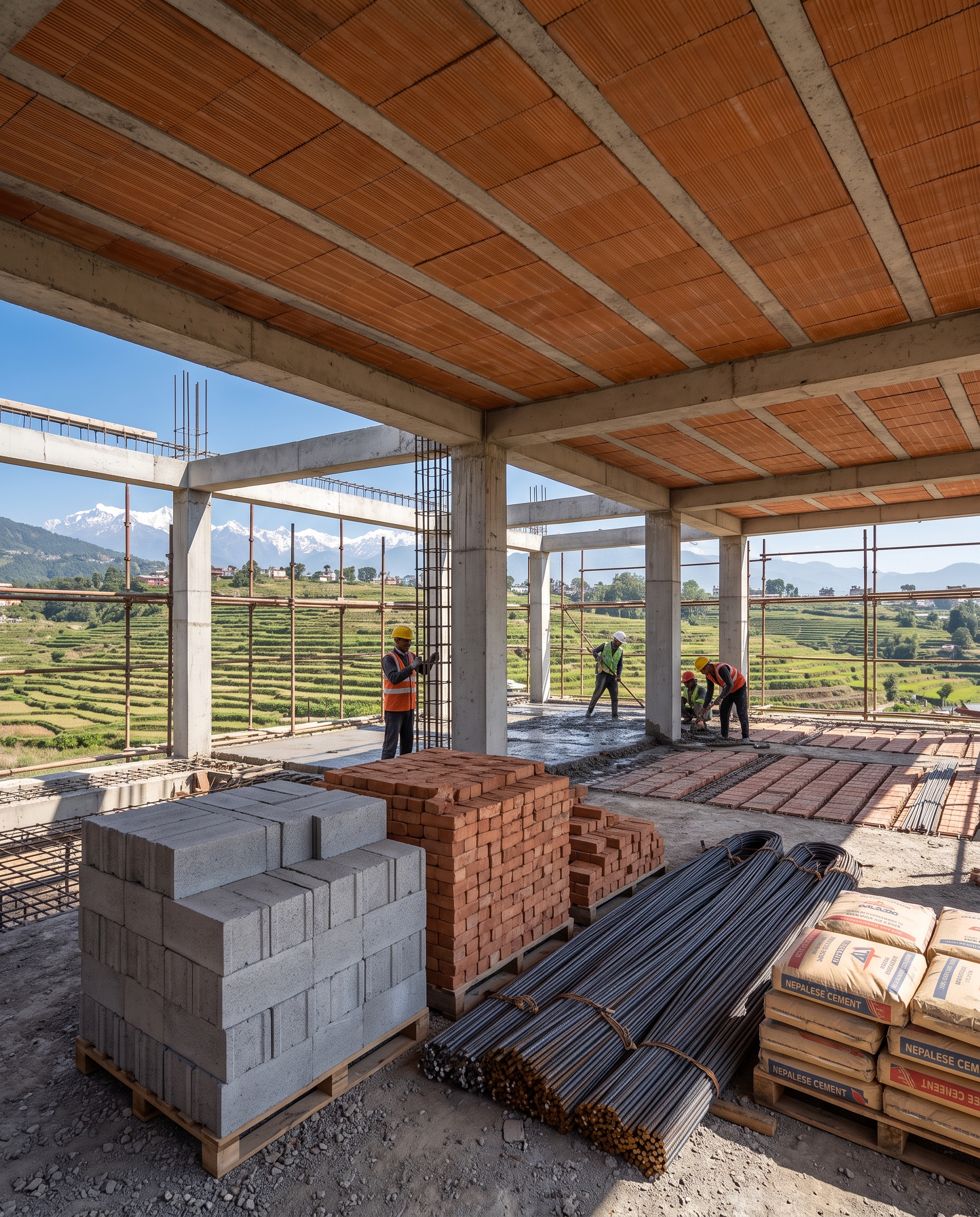
Beyond the Per Square Foot Myth: Real Savings in Nepali Construction
You’ve likely heard the neighborhood gossip in Kathmandu or Butwal: "Building a house now costs at least 4,500 per square foot." While market rates for cement and TMT bars fluctuate, the real reason most Nepali homeowners overspend isn't just inflation—it’s structural over-engineering and material mismanagement. If you are planning your dream home, you don't need to sacrifice the strength of your pillar system to save money. Instead, you need to focus on smarter site execution and material selection that aligns with our unique climate and geography.
1. Rethinking the Slab: The 5-Inch Standard vs. Reality
In many residential projects across the Terai and hills, contractors often push for thicker slabs, believing 'thicker is stronger.' However, for a standard residential span, a properly engineered 5-inch (125mm) slab is often more than sufficient. Every half-inch of extra thickness across a 1,000 sq. ft. floor adds nearly 40-50 bags of cement, plus extra sand, aggregate, and dead load on your beams.
- Action Step: Insist on a structural analysis from your engineer. If the room spans are small, don't let the 'thekedar' convince you to pour a 6-inch slab 'just to be safe.'
- The Benefit: You save on material costs and reduce the weight the pillars have to carry, which is crucial for earthquake safety in Nepal.
2. Transitioning to AAC Blocks for Internal Partitioning
Traditional red bricks from Bhaktapur or Rautahat are iconic, but they are heavy and labor-intensive. For internal partition walls that aren't load-bearing, Autoclaved Aerated Concrete (AAC) blocks are a game-changer for cost-saving tips for building a home in Nepal.
- Weight Reduction: AAC blocks are about 1/3rd the weight of red bricks, reducing the total load on your foundation.
- Plaster Savings: Because AAC blocks are larger and have a smoother surface, you spend significantly less on cement-sand plastering compared to uneven red bricks.
- Thermal Insulation: They keep your home cooler in the scorching heat of Nepalgunj and warmer in the Kathmandu winters.
3. The 'Bulk Buy' Trap and Smart Inventory Management
Many homeowners buy all their tiles or bathroom fittings at once to get a discount. In Nepal’s chaotic site conditions, storing these items for months often leads to breakage, theft, or moisture damage. Real cost-saving happens through 'Just-in-Time' delivery.
- Buy Cement in Batches: Cement loses its strength (grade) the longer it sits in a humid shed. Buy only what you need for the next 15 days.
- Avoid Waste: Ensure your reinforcement bars (rebar) are cut according to a 'Bar Bending Schedule' (BBS). Random cutting leads to 5-10% wastage—money literally thrown into the scrap pile.
4. Finishing: The 'Grey Structure First' Philosophy
One of the biggest mistakes in Nepal is starting expensive interior finishes before the house is weather-proofed. To manage your budget effectively, focus 100% of your initial funds on a high-quality 'Grey Structure' (pillars, slabs, and brickwork).
Expensive Italian marble or imported chandeliers can wait. If you run out of budget mid-way because you bought premium faucets early on, you'll be left with an unfinished shell. Use local stones like Udaipur Marble or Godawari Marble for a premium look at a fraction of the cost of imports.
5. Site Supervision: Preventing the 'Re-work' Tax
The most expensive word in Nepali construction is "Bhatkaune" (demolishing). A door placed 6 inches off from the Vastu-approved location or a plumbing pipe forgotten in a beam can cost you thousands in labor and materials to fix.
- Presence Matters: If you cannot be on-site, hire a junior supervisor. Their salary is often less than the cost of one major mistake made by an unsupervised crew.
- Check Centering and Shuttering: Ensure the wooden or steel props are firm before pouring concrete. A 'bulged' column or a sagging slab is a permanent, costly flaw.
Key Takeaway for Your Nepali Home
Building a home is likely the largest investment of your life. Saving money doesn't mean buying sub-standard rods or cheap cement; it means being precise with measurements, choosing modern materials like AAC blocks, and preventing site waste. By focusing on structural efficiency rather than just the lowest price per bag, you build a house that is both economical and resilient. If you want to ensure your layout is both cost-effective and harmonized with Vastu Shastra, feel free to reach out to Vastuveda Designs for a professional consultation.