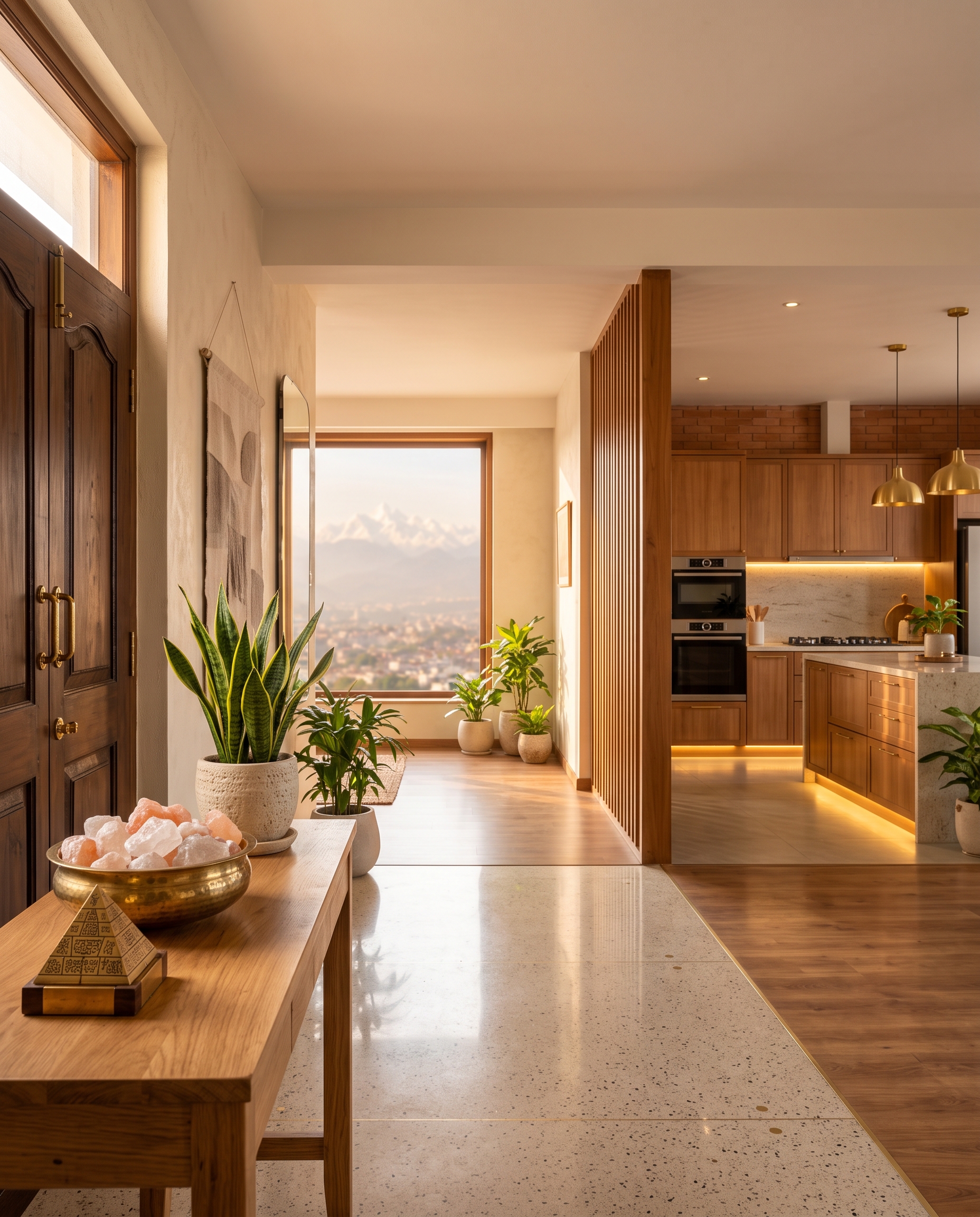
The 'Corner Plot' Dilemma in Kathmandu's Architecture
You’ve finally secured a 4-aana plot in a prime area like Bhaisepati or Budhanilkantha. The land is expensive, the shape is slightly irregular, and to maximize space, your architect suggests placing the main entrance in the South-West. Suddenly, you feel a sense of hesitation. In the traditional science of Vastu Shastra, the South-West (Nairitya) is considered the zone of stability, but it is often the most problematic place for a door or a water element.
In the narrow gallis of Kathmandu or the rapidly expanding settlements of Butwal and Itahari, we don't always have the luxury of a perfect North-East facing plot. Most Nepali homeowners face 'Vastu compromises' due to road access and municipal building bylaws. However, Vastu is not about breaking walls; it is about balancing energies. If your kitchen is in the wrong corner or your main door feels 'heavy,' there are structural and elemental fixes that work within our local building practices.
The South-West Entrance: Why it Heavy and How to Lighten It
The South-West corner is governed by the earth element. When you puncture this zone with a large main entrance, it is believed to lead to 'energy leakage,' often manifesting as financial instability or health issues for the head of the household. In Nepal, where we value the 'Mula Ghar' (main house) stability, this is a significant concern.
If your house is already built and the entrance is fixed in the South-West, do not panic. You can neutralize the effects with these specific remedies:
- The Lead Metal Fix: Place a lead metal strip or three lead pyramids under the threshold of the door. Lead is a heavy metal that represents the earth element and helps 'seal' the energy leakage.
- Color Correction: Avoid blue or black paints on a South-West door. Instead, opt for earthy tones like beige, light yellow, or cream. These colors resonate with the Prithvi (Earth) Tattva.
- The Symbol of Protection: Installing a pair of Hanuman Chalisa or a Panchmukhi Hanuman image above the door from the outside acts as a spiritual shield.
The Kitchen Conflict: Balancing Fire and Water
In many Nepali households, the kitchen is the heart of the home where the 'Chulo' (stove) is worshipped. According to Vastu Shastra, the ideal location for the kitchen is the South-East (Agneya Kon), the direction of the Fire God. However, with modern apartment living in areas like Sanepa or Sitapaila, we often find kitchens placed in the North-East.
A kitchen in the North-East is a major 'Vastu Dosha' because it brings fire into the water zone. This can lead to hot tempers among family members and digestive health issues. To fix this without moving your plumbing:
- Stone Placement: If your stove is in the North-East, place a small slab of yellow marble or Jaisalmer stone under the gas stove. This acts as a buffer between the fire and the floor.
- Color Therapy: Use lemon yellow or off-white for the kitchen walls. Avoid bright red or deep blue tiles in a North-East kitchen.
- The Copper Pyramid: Place a small copper pyramid on the South-East wall of that specific room to symbolically represent the fire element in its correct place.
Bedroom Wisdom: Avoiding the 'Napping' Pitfalls
The Master Bedroom should ideally be in the South-West to ensure the owner remains the 'anchor' of the family. If your bedroom is in the North-West (the zone of air/Vayu), you might find yourself feeling restless or traveling too much without results. In our experience at Vastuveda Designs, we see many young professionals in Kathmandu struggling with sleep quality due to poor bed alignment.
Practical adjustments for your bedroom:
- Head Direction: Always sleep with your head pointing South or East. Never point your head towards the North, as it aligns your body's magnetic field against the Earth's, leading to disturbed sleep.
- Mirror Placement: Ensure that no mirror reflects your bed while you are sleeping. In Nepali homes, we often have large cupboards with mirrors. If it faces the bed, cover it with a light curtain at night.
- Material Choice: Use solid wood beds (like Sisau or Sahal) rather than wrought iron. Wood is a natural insulator and provides better grounding energy.
Cost-Effective Vastu Remedies in the Nepali Context
Correcting Vastu does not have to cost lakhs of NPR. While a full structural renovation is expensive, most 'Dosh' can be mitigated for under NPR 15,000 to 20,000 using simple elemental fixes:
- Sea Salt Shuddhi: Wipe your floors once a week with water mixed with sea salt (Sada Noon) to clear stagnant energy.
- Plants: Use Tulsi in the North-East and heavy indoor plants like a Rubber Plant or Snake Plant in the South-West corners.
- Brass Strips: For doors in the North-West, a brass strip embedded in the floor can help balance the air element.
Key Takeaway for Homeowners
Vastu Shastra is a science of optimization, not a list of fears. Whether you are building a new villa in Pokhara or renovating an old flat in Lalitpur, the goal is to make the space support your mental and physical well-being. If your home layout isn't 'perfect,' focus on the remedies that balance the five elements—Earth, Water, Fire, Air, and Space.
At Vastuveda Designs, we specialize in merging contemporary Nepali architecture with deep Vastu insights. If you are worried about your home’s energy or are planning a new build, let's look at your floor plan together to ensure your space works for you, not against you.